
Definition of Lawn Mowing Robot
A lawn mowing robot is an automatic lawn trimmer. It can navigate autonomously within preset boundary lines via programmed settings. Also known as an autonomous lawn mower, it communicates with the base station through radio frequency and returns to the charging station for automatic recharging.
Working Principle of Lawn Mowing Robots
Lawn mowing robots are powered by rechargeable batteries. They adopt sensors, boundary wires, beacons or GPS technology to perceive surroundings and avoid obstacles. Equipped with cutting blades or grass shredding structures, they cut grass clippings and scatter them on the ground, a process called grass mulching that helps maintain lawn health.
The robot travels along preset routes, mostly in straight lines, across the yard. When reaching the lawn edge, built-in sensors detect the pre-set invisible boundary lines and automatically turn around to continue operation. Intelligent models can even memorize turning positions to carry out subsequent mowing work efficiently.
Traditional lawn mowing robots rely on boundary wires, which can be buried underground or laid on the ground. Users can customize mowing areas with these wires and mark off flower beds, landscape zones, ponds and other restricted zones.

Types of Lawn Mowing Robots
Lawn mowing robots come in various shapes, sizes and functions, and their core difference lies in the boundary positioning technology they adopt.
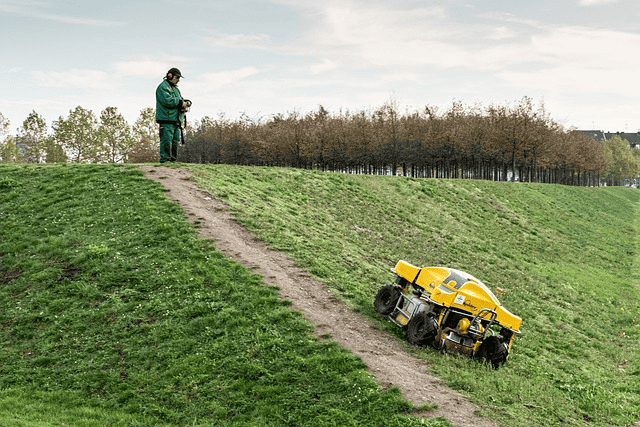
1. Physical Boundary Lawn Mower
This type relies on invisible boundary wires for navigation, which need to be installed in advance. Users can customize the mowing range and enable the robot to bypass obstacles and restricted areas such as gardens and flower beds.
The lawn boundary wire is generally a thin iron wire wrapped with PVC sheath, with both ends connected to the robot charging station. It can be laid freely in any shape to enclose the entire lawn area.
The charger transmits weak electric current through the boundary wire, forming a magnetic field around the designated working area.
Built-in sensors inside the robot can sense proximity to the boundary. When approaching the wire, the magnetic field sends out signals to prompt the robot to turn around and continue mowing.
The wires outside the lawn generate reverse magnetic fields. Once the robot strays out of the preset range, the system will detect the abnormality instantly and send alerts via the management APP.
Higher risks of boundary deviation may occur on steep slopes, during power outages, or when the boundary wire is damaged or the robot sensor malfunctions.
2. Virtual Boundary Lawn Mower
It requires no physical boundary wires to limit its moving range. Instead, it adopts sensors and machine learning technology to identify boundary ranges and realize fully autonomous operation without wired layout.
Virtual boundary positioning technologies vary by manufacturers, most of which apply GPS, Bluetooth beacons and machine learning algorithms for accurate navigation. All virtual boundary mowers are equipped with sensors to identify physical landmarks, obstacles and terrain changes.
When the courtyard landscape is adjusted, the working boundary of the robot can be updated accordingly. Supported by AI and machine learning, the robot is capable of continuous learning and automatic adaptation to the surrounding environment.
Core Component of Lawn Mowing Robots – Ultrasonic Obstacle Avoidance Sensor
Lawn mowing robots working outdoors have an urgent demand for obstacle avoidance. They need to identify debris, trees, fences and other obstacles on the lawn in real time and adjust their driving routes promptly.
Ultrasonic obstacle avoidance sensors can accurately measure surrounding distances and quickly detect the position and spacing of obstacles. They feed environmental sensing data back to the robot control system to match its obstacle avoidance logic, satisfying operational needs including automatic evasion, speed reduction, steering and safe detouring. Hence, they serve as core sensing hardware for lawn mowing robots to achieve intelligent autonomous operation.
Featuring high ranging accuracy, strong anti-glare capability, great adaptability to complex outdoor lawn environments, compact size and easy integration, these sensors are installed around the robot body. They transmit and receive ultrasonic signals continuously to swiftly detect stones, stumps, railings, sundries and low vegetation on the lawn, and accurately calculate the distance and direction of obstacles.
The collected distance data is transmitted to the main control system in real time, providing solid data support for the robot to execute commands such as slowing down, detouring, stopping and turning. It effectively prevents body collision and blade scratching, ensures stable and safe automatic movement in courtyards, parks and other outdoor scenarios, optimizes travel paths, reduces working blind areas, and greatly improves the smoothness, safety and intelligence of fully automatic lawn mowing work.
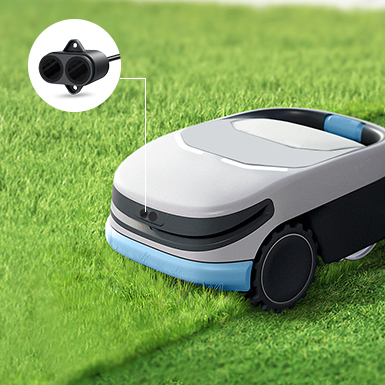
Expert in the Field of Ultrasonic Sensors
Founded in 2008, Shenzhen Dianyingpu Technology Co., Ltd. is a professional manufacturer of ultrasonic obstacle avoidance sensors. With 18 years of profound industry experience, the company has independently developed the DYP-A25 module specially designed for obstacle avoidance of lawn mowing robots.
Equipped with self-developed heterodyne acoustic wave processing technology, DYP-A25 can accurately identify and filter out different-frequency acoustic interference, delivering more stable and reliable output data. It effectively reduces the possibility of ultrasonic co-frequency crosstalk, and fully meets the practical application demands of robotic automatic control in various complex scenarios.
Focusing deeply on the obstacle avoidance track for lawn mowing robots, Dianyingpu will keep polishing high-quality ultrasonic sensing products, empower industrial development with solid core technologies, and cooperate with all partners to build a new ecosystem of intelligent outdoor operation.
Post time: May-18-2026